EPA target: indoor RH 30-50%, never above 60%. Above 60% for 48 hours = mold growth conditions per EPA and CDC. That's the cliff. The musty smell is mVOCs (microbial volatile organic compounds), mold colonies already established, typically 6-8 weeks of growth before you can smell it.
Measure first, don't buy anything until you have data
Buy a Govee H5075 ($12) or ThermoPro TP49 ($10). Place one near the stairs, one near the suspected wet wall, one near the dryer / utility area. Log RH every hour for one full week through a humid stretch.
Read the data:
- 30-50%: you're fine.
- 50-60%: marginal, fix before mold season.
- 60-70%: mold conditions present per EPA, act now.
- 70%+: actively dangerous.
Do not buy a dehumidifier without this data. You can't size what you haven't measured.
The 6 real causes of a humid basement, ranked by likelihood
(1) Inadequate dehumidification (~60% of cases). A 30-pint portable from the big-box store, sitting in the corner of a 1,500 sqft basement with a saturated soil load in August, is not going to hold 50% RH. It will run 24/7, burn 600+ kWh/month, and still read 65%. Capacity math: Aprilaire's own sizing chart calls for 70 pints/day on a "moderately damp" 2,200 sqft basement and 100 pints/day on "wet." The portable in your basement is half the size it needs to be. See best dehumidifiers 2026.
(2) Foundation water intrusion, capillary wicking. Concrete is not waterproof. It's a wick. Hydrostatic pressure from saturated soil pushes vapor (and sometimes liquid) through the slab and walls. You won't see a puddle, you'll see efflorescence (white chalky residue) at the base of the wall and a dark band 6-12" up. UMN Extension confirms this is the dominant slow-source pathway.
(3) Plumbing leak, slow drip. Check every supply joint, every shutoff, the water heater drip pan, and the condensate line from the HVAC. A leak adding one cup per hour to a closed basement is 1.5 gallons/day of evaporative load, enough to swamp a 50-pint dehumidifier.
(4) HVAC ductwork sweating. Uninsulated supply trunks running 55°F air through 75°F / 70% RH basement air = condensation on the duct skin. Water drips, soaks the joist bay, and feeds mold in the cavity. Diagnostic: feel the duct in August. If it's wet, that's your problem. Fix: wrap with R-6 closed-cell duct insulation ($80 DIY).
(5) Dryer venting wrong. IRC 2021 M1502: dryer exhaust must discharge outdoors, in rigid metal duct, with rigid metal transition limited to 8 feet. I see plastic flex venting into the basement ceiling all the time. A single dryer cycle dumps ~1.5 gallons of water vapor. Five cycles a week into your basement = 7+ gallons of water you're paying a dehumidifier to remove.
(6) Crawlspace / no vapor barrier. If there's a crawl under the basement (split-level homes), or exposed earth in any portion, that's a 24/7 moisture source. ASHRAE 62.2 explicitly says exposed earth is NOT part of the pressure boundary, it leaks. Fix: 6-mil poly across the dirt, taped at seams, run 6" up the wall.
The mold math, why 60% RH for 48 hours is the whole game
EPA and CDC are aligned: wet materials that stay wet for 24-48 hours will grow mold (EPA Mold Course Chapter 2). Sustained RH above 60% creates condensation on cool surfaces (foundation walls, ductwork, cold-water pipes), and those surfaces stay wet for days. 60% RH for 48 hours is the mold-growth threshold no homeowner thinks about, they wait until they can smell it, which is roughly 6-8 weeks of growth.
The musty smell is mVOCs (microbial volatile organic compounds), the metabolic exhaust of mold colonies already established in the joist bays, behind drywall, or in stored cardboard.
Solutions by cause
| Cause | Right fix | Cost |
|---|---|---|
| Undersized dehumidifier | Aprilaire E070 (70 pt, ducted) or E100 (100 pt), drain-piped, no bucket | $1,400-$2,200 |
| Portable, modest basement | Midea Cube 50-pint (built-in pump) or Frigidaire 50-pint | $250-$350 |
| Wicking foundation | Interior vapor barrier + dimple board. Serious cases: exterior membrane | $500 DIY → $8K+ pro |
| Plumbing leak | Find and fix. Check water heater first | $0-$500 |
| Sweating ducts | Wrap with R-6 closed-cell duct insulation | $80 DIY |
| Dryer venting | Rigid 4" galvanized to exterior, 8 ft max transition, backdraft damper (IRC M1502) | $40-$120 DIY |
| Crawl / exposed earth | 6-mil poly vapor barrier, taped seams | $100-$250 DIY |
When to stop DIY and call a pro
- Visible mold patches >10 sqft (EPA's DIY threshold)
- Active water seepage during rain
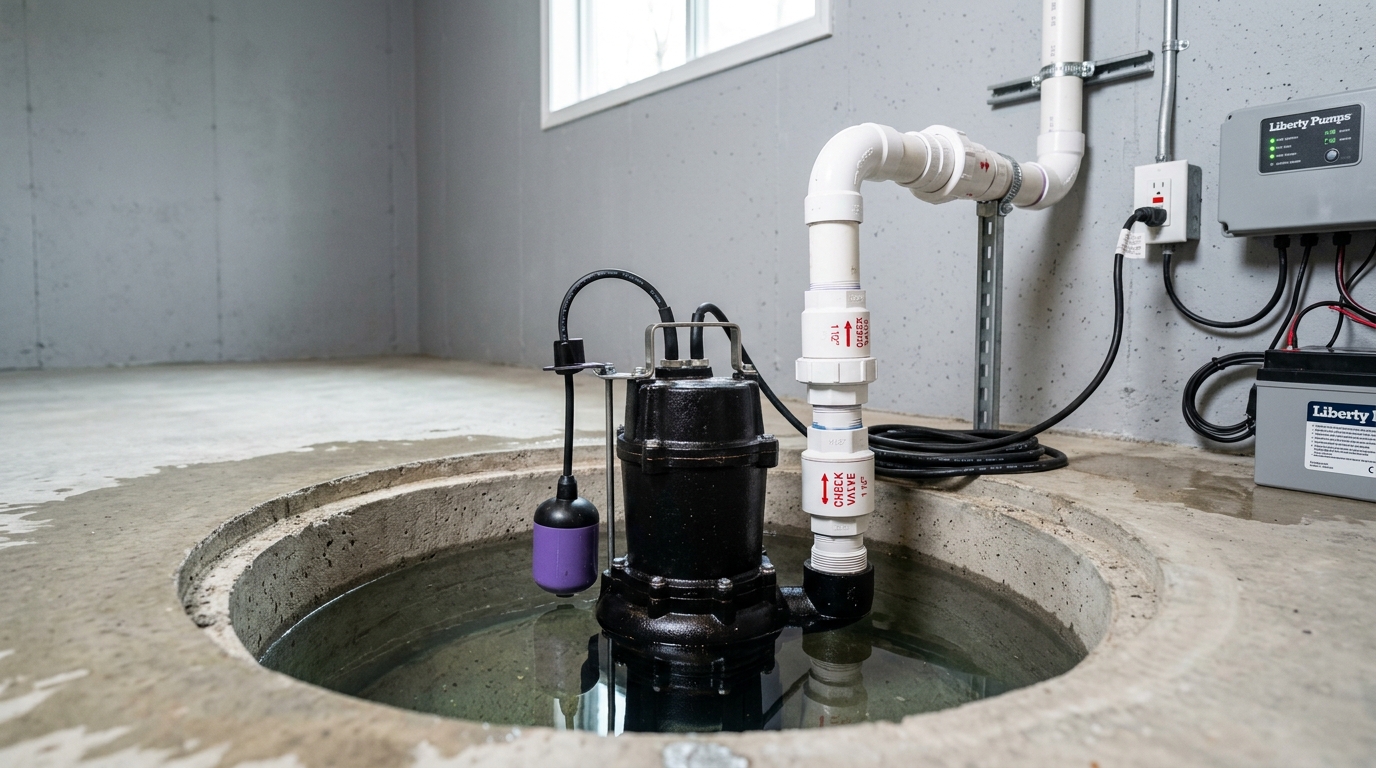
- Sump pump failed or non-existent in a basement that needs one
- Cracking in foundation walls (structural, not just cosmetic)
- HVAC condensate pan overflowing repeatedly
FAQ
What humidity is too high in a basement?
Anything above 60% RH per EPA. Target 30-50%. Above 60% for 48 hours starts mold.
Should I run a dehumidifier in basement all year?
In most climates, yes: May through October hard, plus shoulder season. Set to 50% and let it cycle.
Why is my basement humid in summer when it's dry outside?
Summer outside air at 75°F / 60% RH hits 65°F basement walls and condenses. Opening basement windows in summer makes it worse, not better.
Does a dehumidifier cool the basement?
No, warms it slightly (heat of condensation + compressor heat). It dries it.
Can I just use DampRid?
Only for ~50 sqft closets. A whole basement needs mechanical dehumidification.
Field-pattern callout
"Bought a 30-pint Frigidaire from Home Depot. Runs 24/7 in my 1,400 sqft basement, empties the bucket twice a day, and the hygrometer still reads 64%. What gives?"
Diagnosis: Undersized by half. A 1,400 sqft "moderately damp" basement needs 50-70 pints/day minimum, hard-piped to a floor drain. The 30-pint unit is doing exactly what its spec sheet promised, it's the wrong tool. Upgrade to a Midea Cube 50-pint with built-in pump (~$300) or, if the basement runs perpetually wet, an Aprilaire E070 ducted unit (~$1,400 installed). The cheap unit isn't broken. It's outmatched.
Related guides
- Best dehumidifiers 2026, sizing math + cold-tolerant garage picks
- Best basement waterproofing products 2026, when paint won't fix water
- Best sump pumps 2026, when the seepage is too much for dehumidification alone
- Recalled dehumidifier replacement, check your unit against the fire recalls before running it another season
Editorial standards: Cited authorities include EPA Brief Guide to Mold, Moisture and Your Home. EPA Mold Course Chapter 2. CDC mold/dampness guidance. UMN Extension Moisture in Basements. ASHRAE 62.2-2022 ventilation. IRC 2021 M1502 dryer vent code. Reviewed by Al, Building Doctor, IUOE Local 39 Stationary Engineer, EPA Universal.