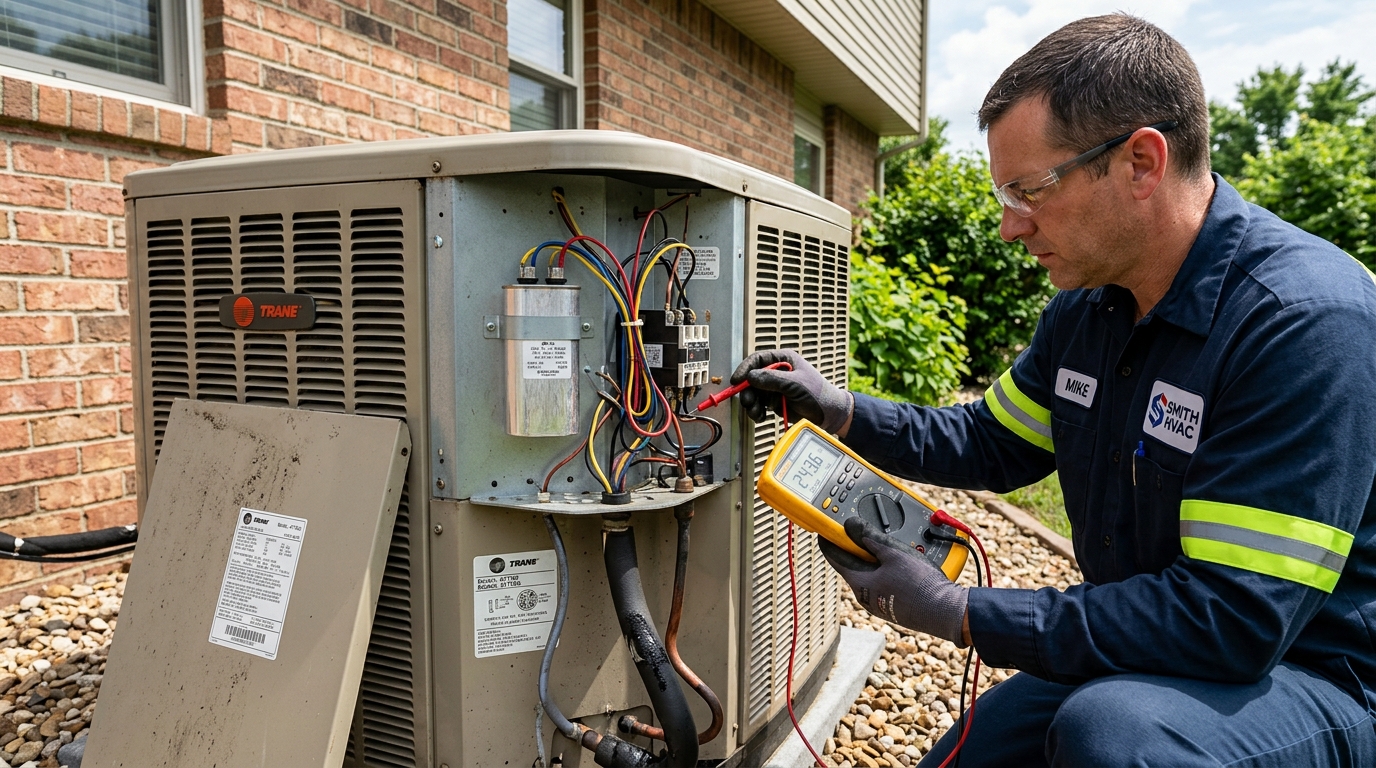
The 6 causes ranked by field frequency
| # | Cause | Field frequency | Fix |
|---|---|---|---|
| 1 | Oversized unit (Manual J wasn't done) | ~40% of cases | Live with it or replace right-sized |
| 2 | Thermostat swing too tight / location too close to register | ~20% | Widen swing to 1.5-2°F. Relocate thermostat |
| 3 | Dirty filter / restricted airflow | ~15% | Replace filter, check duct restrictions |
| 4 | Low refrigerant (= leak) | ~10% | EPA-cert tech only, leak search + recharge |
| 5 | Failed reversing valve or solenoid | ~8% | Tech replacement |
| 6 | Defrost cycle stuck or sensor bad (winter only) | ~7% | Tech diagnosis, defrost board or temp sensor |
The oversizing reality, #1 cause nobody wants to fix
Manual J is the ACCA standard load calculation that determines the correct size for an HVAC system. Most residential installers skip it and use square-footage rules of thumb (e.g., 1 ton per 500 sqft). Square-footage rules don't account for insulation quality, window orientation, infiltration, internal heat loads, climate zone, or duct condition, all of which dramatically change the actual load. Result: 30-50% oversizing is normal.
Why installers oversize:
- Protects against "it doesn't keep up" complaints
- Easier to spec than running a load calc
- Customer thinks bigger is better and won't complain about cost
- If the unit's too small, the installer eats the change-out. If it's too big, customer eats the short-cycling problem 7 years later when warranty's done.
The fix: if you're getting quotes for a new install, insist on a Manual J printout before signing. If they refuse, find another installer. If you already have an oversized unit short-cycling, you have two options: (1) live with it and accept reduced compressor life, or (2) replace with a right-sized variable-speed unit that handles partial loads through modulation rather than cycling.
Diagnostic flow
- Time the cycles. Watch a full cooling or heating call for one hour. Count cycles and time them. 8-15 min runtime in mild weather is healthy. <5 min cycles = short cycling.
- Check the filter. If you can't see light through it, replace. Run 24 hrs with a clean filter and re-time cycles.
- Check thermostat settings. Cycles-per-hour setting (CPH) should be 3 max for heat pumps. Temp swing 1-2°F. Anti-short-cycle delay (off-time) should be 5 minutes minimum.
- Verify outdoor coil clean and unobstructed. See how to clean the condenser coil.
- If still short-cycling after 1-4: EPA-cert tech call. Likely refrigerant charge issue, failed sensor, or defrost board.
Smart thermostat short-cycle settings
| Thermostat | Setting to check | Recommended |
|---|---|---|
| Ecobee Premium | Heat pump CPH (cycles per hour) | 2-3 max |
| Nest Learning 4th gen | Schedule + Eco temp swing | 1.5-2°F swing |
| Honeywell T9 | Cycle rate (under Installer settings) | 3 max for heat pump |
| Any thermostat | Anti-short-cycle delay | 5 min min, 10 min ideal |
FAQ
Is short cycling bad for a heat pump?
Yes. Every start draws 4-8× running current. Wears contactor, overheats windings. Shortens life from 15 yrs to 5.
How often should a heat pump cycle?
Mild weather: 2-3 cycles/hr, 8-15 min runtime each. Design temp: continuous run is healthy. <5 min cycles = short cycling.
What size heat pump do I need?
ACCA Manual J load calc, not square-foot rules. Most installers oversize 30-50%. 2,200 sqft mixed-climate house typically 3-4 tons properly sized.
Can a smart thermostat cause short cycling?
Yes, if CPH setting too aggressive or temp swing too tight. 1.5-2°F swing for single-stage. 5-min anti-short-cycle delay minimum.
Related guides
- Best mini-split heat pumps 2026, what to replace an oversized unit with (variable-speed)
- AC blowing warm air, adjacent diagnostic
- Best AC capacitor replacement 2026, short-cycling kills capacitors first
Editorial standards: Cited authorities include ACCA Manual J residential load calculation, EPA Section 608 refrigerant management. Reviewed by Al, Building Doctor, EPA Universal, IUOE Local 39.