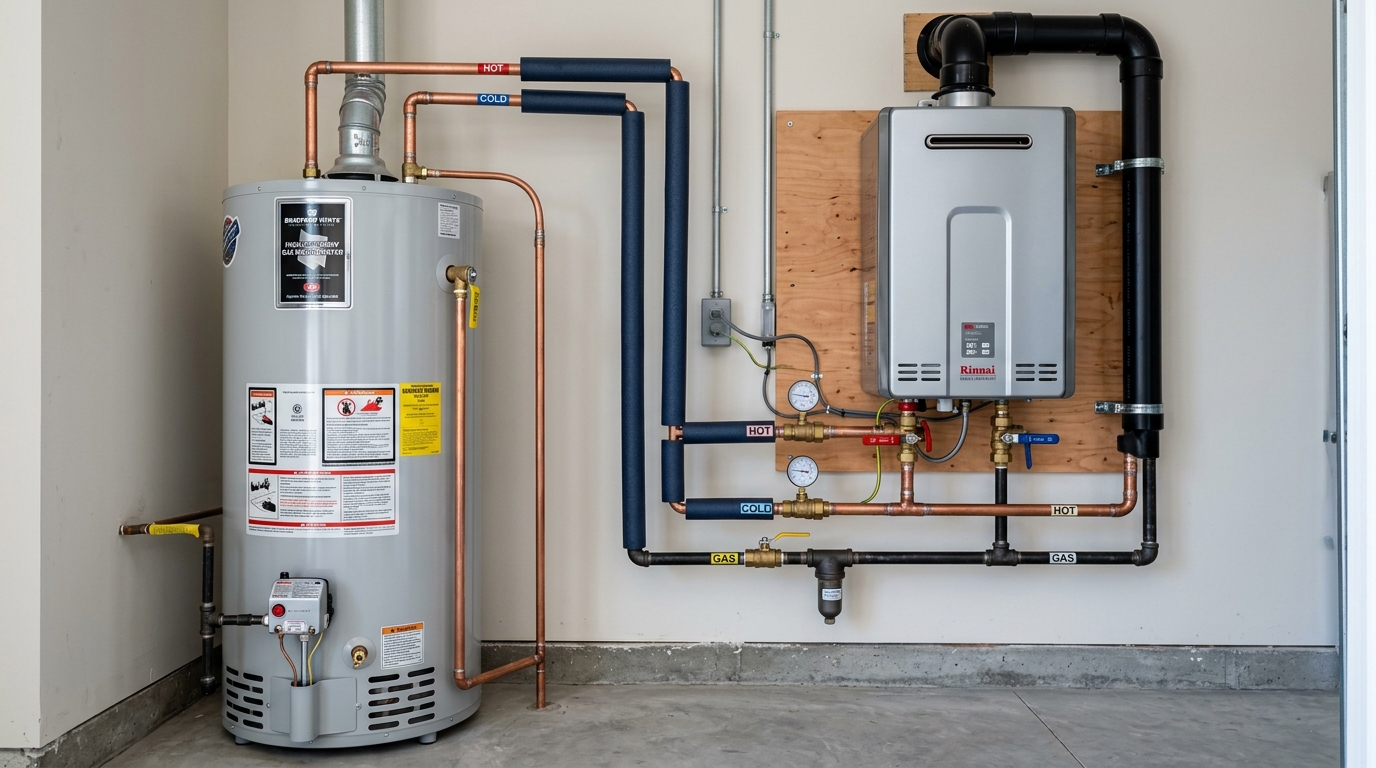
Rinnai, Navien, Rheem warranty terms commonly require documented descaling. Skip it and a warranty claim for a clogged heat exchanger is on you. Write the descale date on a piece of tape stuck to the unit cover.
Gear you need
- Submersible pump + hose kit ($50-$90): Eccotemp EZ-Flush, Calci-Clean, or generic. One-time buy, lasts forever. Don't try to skip this.
- 5-gallon bucket (clean, no detergent residue).
- Two 3/4" washing-machine hoses, usually come with the pump kit.
- 4 gallons white vinegar (5% acetic acid, grocery store) OR CLR Pro Calcium Lime Rust Remover (1 gal concentrate diluted per label). Vinegar = non-toxic, gentler, 60 min. CLR = stronger, 45 min, more careful disposal.
The 7-step procedure
- Power off + gas off. Shut off the unit switch or breaker. Shut off the gas valve. Wait 15 minutes for the heat exchanger to cool.
- Shut off water + isolate. Close the hot-side and cold-side isolation (service) valves, handles labeled HOT/COLD. Open the small drain ports on each service valve over a bucket to relieve pressure.
- Connect hoses. One hose: from the cold-side drain port to the submersible pump (inside the bucket). Second hose: from the hot-side drain port back into the bucket. Now you have a closed loop.
- Fill with descaler. Pour 4 gallons of vinegar (or CLR per label) into the bucket. Open both service-valve drain ports.
- Run the pump 45-60 min. Descaler circulates through the heat exchanger and back to the bucket. You'll see scale chunks accumulate in the bucket, that's the goal. On hard water, the bucket will look like the bottom of a coffee pot.
- Flush with fresh water, the half-step nobody skips. Turn off the pump. Dump the descaler bucket. Disconnect the pump return hose. Open the cold-side isolation valve briefly to flush fresh water through the heat exchanger and out the hot-side hose into the bucket. Run for 5 minutes. Vinegar/CLR residue left in the exchanger eats brass fittings and feeds biofilm, flush thoroughly.
- Reconnect + restore. Close service-valve drain ports. Disconnect hoses. Open both isolation valves. Restore gas, then power. Run a hot-water tap for 30 seconds to confirm flow + temperature.
Also do this while you're in there, clean the inlet filter screen
Cold-side has a small filter screen behind a cap near the cold isolation valve. Unscrew the cap, pull the screen, soak in vinegar 5 minutes, rinse, reinstall. Scale and pipe debris accumulate here and restrict flow, most "low hot-water pressure" complaints I take on tankless units trace to this $0 fix.
Vinegar vs CLR, which one
| Factor | White Vinegar | CLR Pro |
|---|---|---|
| Strength | Mild (5% acetic acid) | Strong |
| Time required | 60 min | 45 min |
| Safe for stainless heat exchangers | Yes | Yes (per CLR Pro spec sheet) |
| Safe for copper heat exchangers | Yes | Yes (but flush thoroughly) |
| Disposal | Drain (it's vinegar) | Per label / household chemical disposal |
| Cost (annual descale) | $12 (4 gal grocery store) | $25 (1 gal concentrate) |
| Best for | Soft water, mild scale | Hard water (15+ GPG), thick scale |
Brand-specific notes
- Rinnai (RX, RU, RXP series): isolation valves with built-in drain ports are standard on units sold post-2018. If your install is older, you may need to add isolation-valve kits ($80) before you can descale.
- Navien (NPE, NPN): built-in maintenance kits standard. Same procedure. Some models display a maintenance reminder on the panel after 1,500 hours of runtime.
- Rheem (RTGH): isolation valve kit usually included with new installs. Check for hot/cold labels: Rheem's are sometimes reversed compared to Rinnai conventions.
- Bosch (Greentherm), A.O. Smith, Stiebel Eltron Mini: same general procedure, but verify your specific service-valve port location in the manual before connecting.
FAQ
Vinegar or CLR?
Both work. Vinegar is non-toxic, gentler, 60 min. CLR stronger, 45 min, more disposal care. Hard water (15+ GPG): CLR. Soft water: vinegar.
How often do I descale?
Annual minimum. Every 6 months on hard water (15+ GPG). Warranty terms often require it.
Can I descale without a pump kit?
Not effectively. Static fill doesn't circulate. Pump kit is $50-$90 one-time.
Will descaling fix low hot-water pressure?
Sometimes. Also clean the inlet filter screen (cold side, under cap near isolation valve), most common cause of low flow.
Related guides
- Best tankless water heaters 2026, what to buy when descaling is too late
- Tankless vs tank water heater, the comparison that decides the next replacement
- Best smart water softeners 2026, fix the upstream cause of scale
Editorial standards: Procedure verified against Rinnai, Navien, Rheem service manuals. Reviewed by Al, Building Doctor, IUOE Local 39 Stationary Engineer.