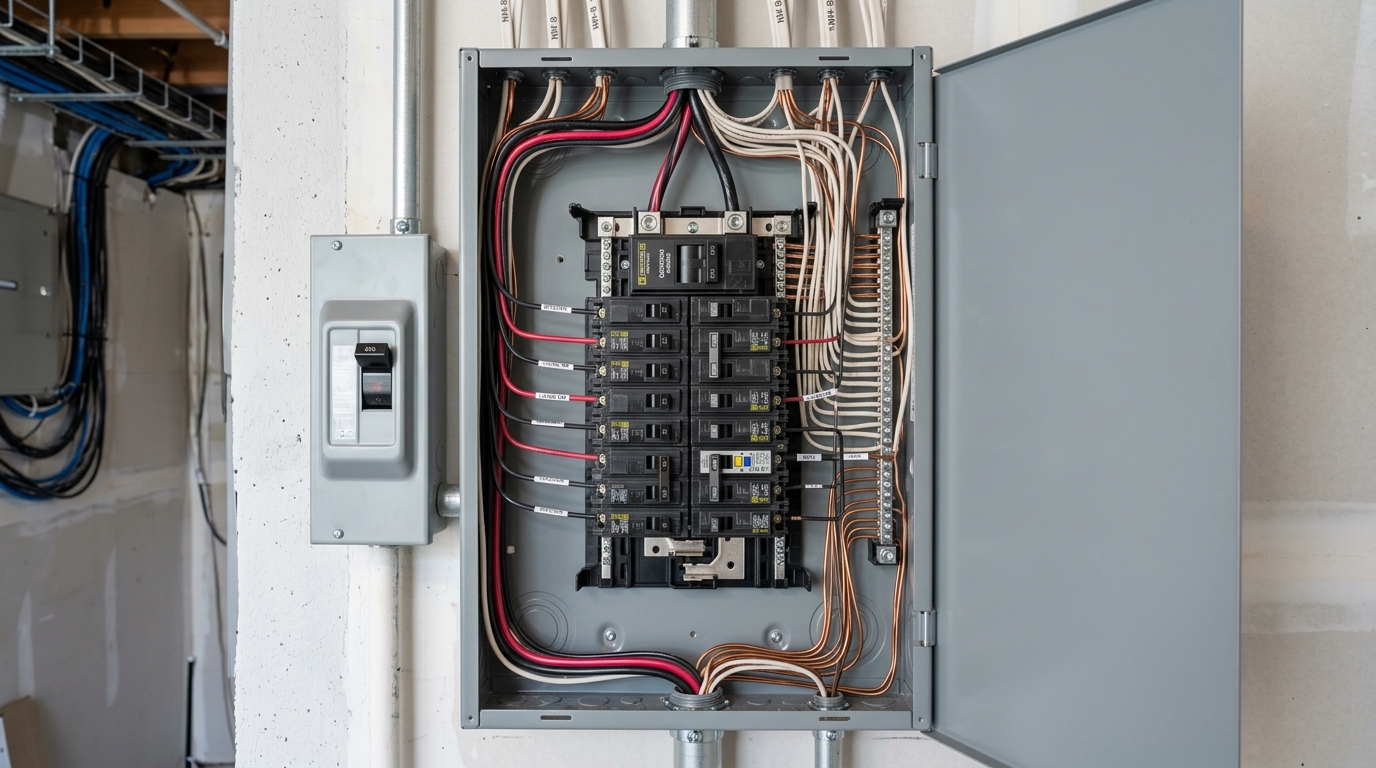
Status: Normal under moderate load.
Cause: Internal bimetallic thermal element dissipating heat.
Action: Monitor; ensure load does not exceed 80% continuous rating (16A on 20A breaker).
Status: Borderline Warning.
Cause: Heavy continuous heating loads (EV charger, space heater, electric dryer).
Action: Shed load. Check lug screw torque to manufacturer spec (NEC 110.14(D)).
Status: Critical Fire Hazard.
Cause: Pitted busbar stab, arcing terminal, or failing bimetal spring.
Action: Kill main breaker immediately. Call licensed electrician for replacement.
Touchable but uncomfortable = ~100-120°F internally = action item. Too hot to touch = 130°F+ = kill the breaker immediately by switching it OFF, then leave it off. Call a licensed electrician same-day. Don't reset it to "check."
The 5 causes ranked by frequency
| # | Cause | Field frequency | Fix |
|---|---|---|---|
| 1 | Loose wire lug at the breaker terminal screw | ~50% | Licensed electrician torques to manufacturer spec (NEC 110.14(D)) |
| 2 | Overloaded circuit (running at 90%+ capacity continuously) | ~20% | Identify high-draw load. Add a dedicated circuit |
| 3 | Failing breaker, internal contacts pitted from repeated trip cycles | ~15% | Electrician replaces breaker ($30-$80 + labor) |
| 4 | Aluminum wiring at breaker (1965-1973) | ~10% | Specialty COPALUM crimps or AlumiConn lugs by qualified electrician |
| 5 | Loose bus-bar connection inside panel | ~5% | Critical, panel-level fault, electrician must verify the entire bus |
NEC 110.14(D), the torque spec nobody follows
The National Electrical Code requires every termination to be torqued to manufacturer specification. For breaker lugs, that's typically 12-25 in-lb (varies by breaker). Field studies show 75% of un-torque-wrenched terminations are wrong. Builders rarely use torque wrenches. Most homeowner-installed circuits never see one. The result is loose lugs that develop resistive heating over years until they finally fail at the worst possible moment.
The fix is mechanical: an electrician opens the panel, kills the main, pulls each suspect wire, re-torques to spec with a calibrated torque wrench. $200-$400 service. Worth it preventively in older panels.
The overload check
Some breakers run hot because the circuit is genuinely running at 90%+ rated capacity continuously. NEC 210.19 limits continuous loads to 80% of breaker rating. A 15A breaker should never see more than 12A continuous (>3 hr). If your electric space heater (1,500W ÷ 120V = 12.5A) is on a 15A general-use circuit also serving lights, you're at 90%+ on the heater alone, plus the lights.
The fix: move the high-draw load to a dedicated circuit. Or stop using the high-draw load on this circuit.
FAQ
Is a hot breaker dangerous?
Yes. Breakers should be ambient. Warmth = loose lug or overload. NFPA: #1 source of panel fires.
Why is one breaker hot but others aren't?
Problem at THIS breaker, loose lug, oxidized contact, or failing internally. Or this is a high-load circuit at 90%+.
Should I replace the breaker myself?
No. Opening a live panel = line-side exposure with no upstream protection. Licensed electrician only.
How hot is too hot?
Noticeably warm = action item. Too hot to touch = 130°F+, kill now.
Related guides
- Breaker keeps tripping, different symptom of related fault
- Outlet warm to touch, same heating cause, different fixture
- Lights flickering, adjacent panel-level diagnostic
Editorial standards: Cited authorities include NEC 110.14(D) torque requirements, NEC 210.19 continuous-load limits, NFPA fire data on panel-level ignition. Reviewed by Al, Building Doctor, 18 years Class A commercial electrical Chief Engineer.