Reader-supported: As an Amazon Associate I earn from qualifying purchases. The picks are mine, affiliates don't pay for placement and don't shape what I recommend.
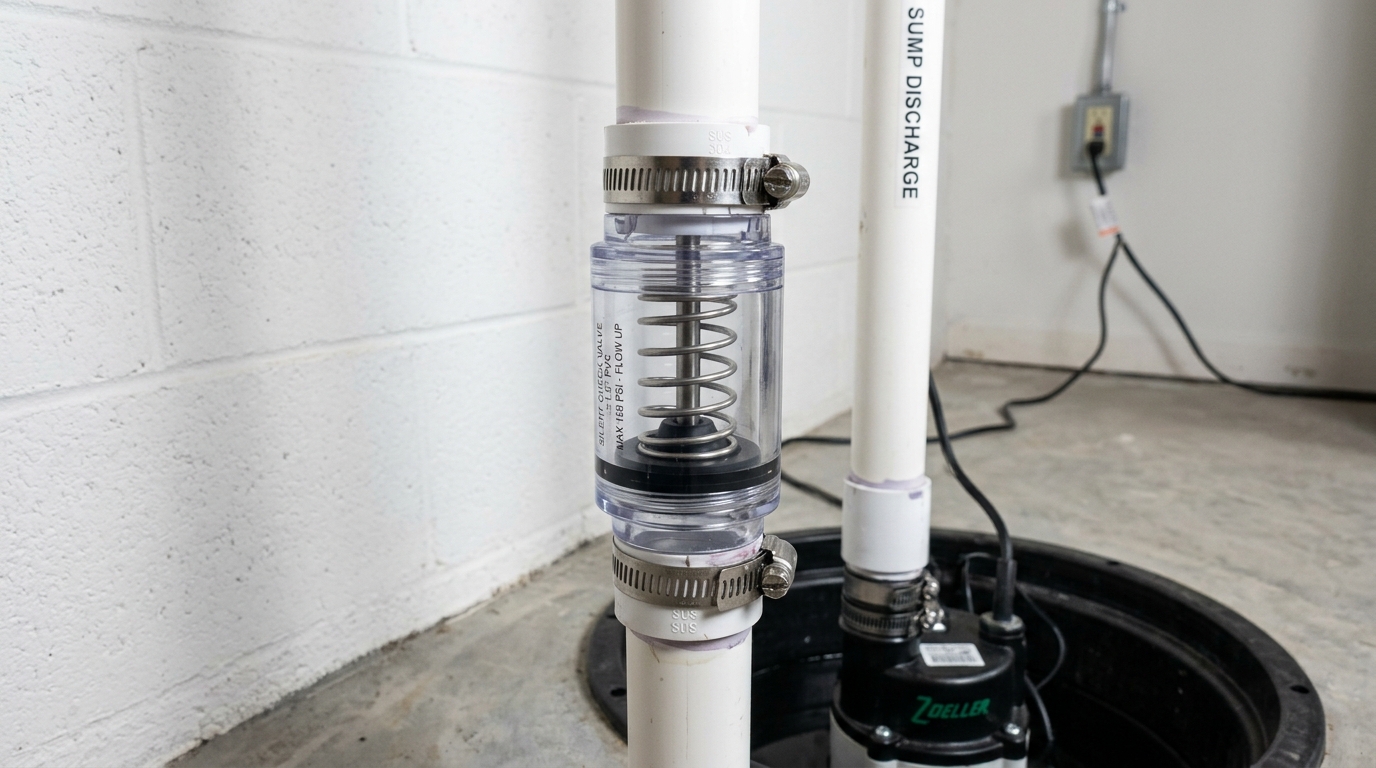
A failing check valve doesn't just make noise; it costs you a pump motor. When the internal rubber flap warps or sticks open, water pumped out of the pit flows right back down the pipe the second the motor stops. The pump short-cycles every 45 seconds, overheating the windings and burning out the stator.
Why standard flapper valves slam (and why springs fix it)
Most builder-grade homes come with a $12 rubber swing check valve. When the pump is pushing 2,500 gallons per hour upward, the rubber flap hangs wide open. The instant the float drops and the motor shuts off, flow velocity stops. But before that gravity flap can swing shut, the 10-to-15-foot column of water resting in the vertical discharge pipe accelerates backward.
That falling column slams the rubber flapper into the valve seat like a sledgehammer hitting an anvil. In plumbing physics, this is known as hydraulic shock. Over months of storm cycles, this repeated hammering weakens glued PVC couplings, rattles pipe brackets loose from foundation walls, and transmits shockwaves into your bedroom floor joists.
A silent spring-loaded check valve solves this with a stainless steel compression spring. As the pump slows down, the spring pushes the disc toward the seat before the water column can reverse. The valve closes smoothly against static water rather than dynamically slamming shut against a falling column.
The 3 best silent sump pump check valves (2026)
Campbell Manufacturing 1.5" Quiet Check Valve (Model B-0822-15C)
The gold standard in mechanical plant rooms and residential basements alike. Features a clear transparent PVC body so you can visually verify flow and flapper seating without taking pipes apart. The heavy-duty spring-loaded disc closes instantly with zero hydraulic shock.
Key specs: 1-1/2" pipe size, rated to 150 PSI, heavy-duty stainless steel hose clamps and flexible neoprene compression sleeves included.
Zoeller 30-0181 Full Flow 1.5" Cast Iron / PVC Silent Valve
Engineered by the premier name in commercial wastewater. Zoeller's spring-loaded inline check valve is built for abusive storm-cycle duties. It features an inline poppet design with a Buna-N rubber flapper that dampens closing shock completely.
Key specs: Dual size compatibility (fits 1-1/4" or 1-1/2" PVC), rated to 50 PSI head pressure, full-flow porting minimizes motor head loss.
Brady Silent Spring Check Valve (1-1/2" Slip / Threaded)
A compact, reliable spring-assist check valve for tight basin openings where bulky rubber boots struggle to fit. Uses an internal stainless spring and elastomer seal that cuts shutdown decibels by over 80% compared to traditional flap valves.
Key specs: Solvent weld slip joints or union ends, corrosion-resistant Delrin internal disc, rated for continuous water service.
Valve comparison: swing flapper vs spring-loaded silent
| Feature | Standard Swing Flapper | Silent Spring-Loaded |
|---|---|---|
| Shutdown Noise | Loud metallic/hydraulic "thud" (65-80 dB) | Near-silent soft click (under 30 dB) |
| Closing Mechanism | Gravity & reverse water weight | Stainless steel compression spring |
| Water Hammer Protection | None (causes shockwave backpressure) | Full elimination of hydraulic shock |
| Visual Diagnostic Body | Opaque white or black PVC (blind) | Clear polycarbonate (see flow & debris) |
| Typical Service Lifespan | 3 to 5 years (hinge pin fatigues) | 8 to 12 years (continuous alignment) |
Step-by-step: 20-minute installation procedure
- Disconnect electrical power: Unplug the primary pump and disconnect any battery backup float sensors. Never cut into pressurized plumbing with the pump energized.
- Capture column water: Position a bucket directly beneath the existing valve. Sump discharge pipes hold about 1 quart of water per foot of 1.5-inch pipe.
- Loosen old band clamps: Use a 5/16-inch nut driver (better than a flathead screwdriver to avoid stripping) to back off the hose clamps on both rubber couplers.
- Check flow orientation: Every silent check valve has a molded directional arrow on the body. Ensure this arrow points UP in the direction of pumped wastewater flow.
- Torque clamps evenly: Slide the rubber boots over the cut PVC ends, seat the valve firmly in the middle, and tighten each clamp to approximately 25 inch-pounds until the rubber visibly compresses into the PVC.
- Weep hole verification: Confirm you have a 3/16-inch weep hole drilled between the pump outlet and the check valve at a downward 45-degree angle. This allows trapped air to vent so the pump doesn't air-lock.
Frequently asked questions
Why does my sump pump make a loud thud when it shuts off?
That violent clunk is hydraulic water hammer caused by a gravity flapper check valve slamming shut when the pump stops. Ten to twenty pounds of water in the vertical discharge pipe suddenly reverses direction, slamming the swing gate into the valve body and vibrating the house framing.
How does a silent spring-loaded check valve stop the noise?
A silent check valve uses a stainless steel compression spring behind a guided disc. As pump velocity drops toward zero, the spring begins closing the disc before the column of water reverses direction, eliminating the sudden impact and silencing the shutdown.
Where should the check valve be installed on the discharge pipe?
Install the check valve between 12 and 24 inches above the sump pump cover or pit rim. Placing it too close to the pump impeller creates turbulent air pockets, while placing it too high increases the volume of backflow resting on the valve disc.
Do I need to drill a weep hole if I install a check valve?
Yes. If your sump pump model does not have an internal air relief port, you must drill a 3/16-inch weep hole at a 45-degree downward angle into the discharge pipe between the pump outlet and the check valve. This prevents air-locking after the pit pumps dry.
Related guides
- Best sump pumps 2026, primary + battery backup redundancy stack.
- Why is your boiler knocking?, water hammer vs air in hydronic loops.
- Best water leak sensors, placement protocols to catch pit overflows early.
- How to shut off water to your house, emergency isolation protocols.
Editorial standards: Technical recommendations grounded in ASPE (American Society of Plumbing Engineers) hydraulic design standards. Reviewed by Al, Building Doctor, IUOE Local 39 Stationary Engineer.