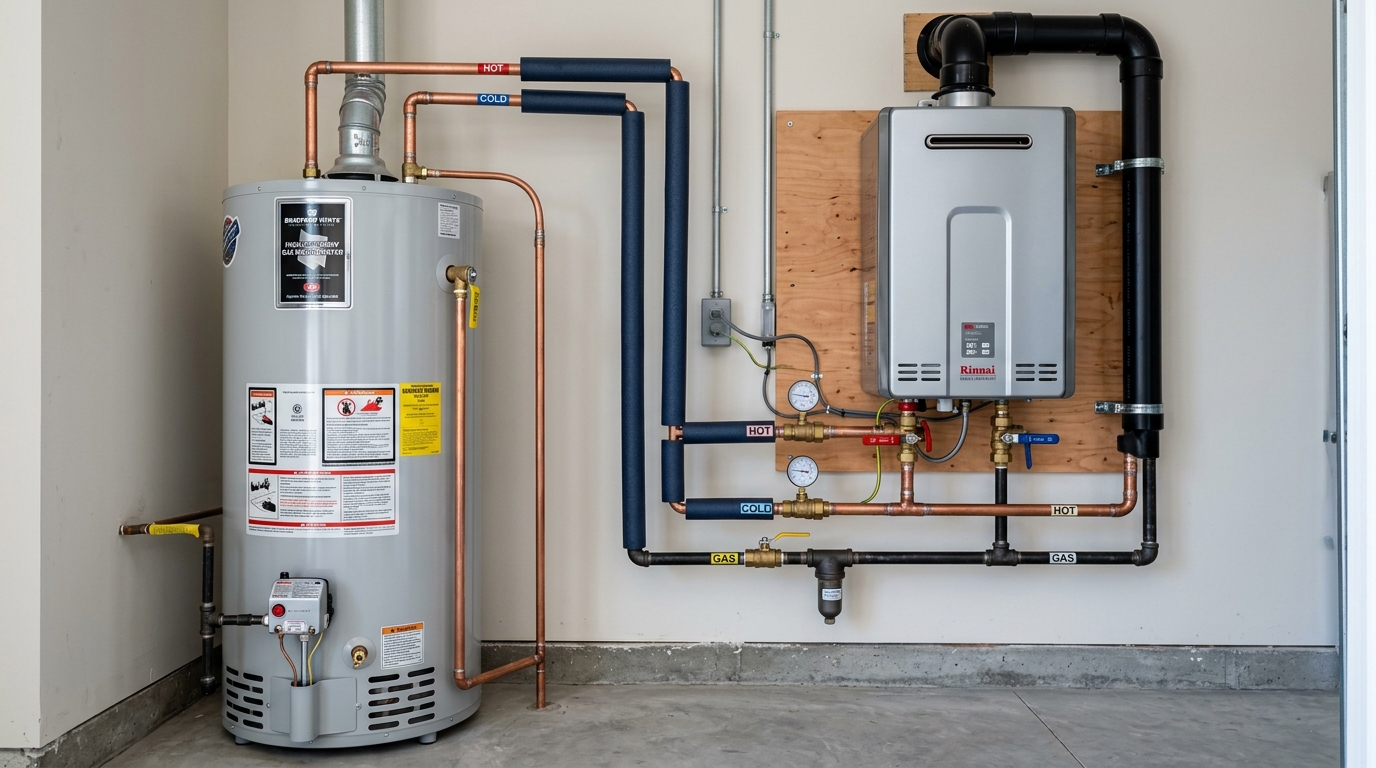
Vent Pipe: PVC, CPVC, or Polypropylene (cheap).
Exhaust Temp: 100°F–140°F.
Requirement: Acidic condensate drain + neutralizer cartridge.
Best For: New installs or replacing long vent runs.
Vent Pipe: Category III AL29-4C Stainless Steel ($40–$75/ft).
Exhaust Temp: 300°F–450°F.
Requirement: Zero condensate drain needed.
Best For: Direct replacement where Category III pipe is already installed.
The head-to-head
| Spec | Non-Condensing | Condensing |
|---|---|---|
| UEF | 0.80-0.83 | 0.95-0.98 |
| Exhaust temperature | 300-450°F | 100-140°F |
| Vent material | Category III stainless steel | PVC or polypropylene |
| Vent cost (15 ft run) | $375-$675 | $120-$180 |
| Condensate drain required? | No | Yes (~1 gal/hr, acidic) |
| Condensate neutralizer | N/A | $60-$120 required |
| Unit price (199k-BTU) | $900-$1,300 | $1,300-$2,000 |
| Total installed cost | $4,500-$6,500 | $5,000-$7,000 |
| Annual gas cost (avg) | $320 | $267 |
| Lifespan | 20 years (with annual descaling) | 20 years (with annual descaling) |
Why condensing usually wins the install math
The unit-price delta is $400. The venting delta is $250-$500 (PVC at $8-$12/ft is much cheaper than Category III stainless at $25-$45/ft over a typical 15-ft run). Net install difference: condensing is often only $100-$300 more, sometimes the same or less.
Add the operating-cost savings, ~$50-$80/yr at typical gas rates and household demand. Over 20-year life, condensing saves $1,000-$1,600 in gas costs. Total 20-year cost-of-ownership: condensing wins by ~$1,000-$2,000.
The condensate drain reality
Condensing units produce 0.8-1.3 gal/hr of mildly acidic condensate (pH ~3-5), concentrated CO₂ from combustion forms carbonic acid as it condenses. Plumbing code requires:
- Neutralizer cartridge ($60-$120), limestone media that raises pH to 6+ before discharge
- Gravity drain or condensate pump, feeds to floor drain, condensate pump if no gravity drain available
- Replace neutralizer media every 6-12 months, $15-$25 refill
This is the #1 code violation I see in DIY tankless installs. Acidic condensate dumped into PVC drain piping eventually softens it. Into a slop sink without neutralizer, the drain trap corrodes.
When non-condensing still wins
- Existing Category III vent chimney in place from an older water heater, you're not paying for new vent
- No floor drain available for condensate, condensate pump adds $200-$400 + electrical work
- Outdoor install, exhaust gases vent directly outdoors, vent material cost-difference is minimal
- Short-stay homes (under 8 years), payback on the UEF premium hasn't kicked in
FAQ
Is condensing tankless worth the extra money?
Yes, almost always. Unit costs $400 more, venting saves $250-$500. Net install often cheaper. Plus 15-18% better UEF.
What's the difference in exhaust temperature?
Non-condensing: 300-450°F (Category III stainless). Condensing: 100-140°F (PVC). Extracted heat = the efficiency gain.
Do condensing units require a drain?
Yes. 0.8-1.3 gal/hr acidic condensate (pH 3-5). Neutralizer cartridge + gravity drain or pump required by code.
Can I retrofit non-condensing to condensing?
Yes but near-full reinstall, vent, drain, often different footprint. $2,500-$4,500 to convert. Worth it only if replacing anyway.
Related guides
- Best tankless water heaters 2026, 5 picks ranked, all condensing
- Tankless vs tank water heater, the prior decision
- How to flush a tankless water heater, annual maintenance for either type
Editorial standards: Cited authorities include DOE UEF test procedure (10 CFR Part 430), IRC 2024 fuel-gas + venting requirements, plumbing code condensate-disposal requirements. Reviewed by Al, Building Doctor, IUOE Local 39 Stationary Engineer.